
Australians sought out petrol price comparison and electric vehicle brands in March amid global fuel crisis – Ipsos iris data
More than 21 million people used a news website or app in March
24 April 2026 – Online audience numbers around fuel comparisons and electric vehicle (EV) brands surged in March, amid widespread concern about global fuel availability, new Ipsos iris data has revealed.
Last month, automotive manufacturing brands, with a strong focus on hybrid and full-battery EVs, showed a significant audience increase across a range of websites and apps, rising by 22% month-on-month and growing by 431,000 people, demonstrating increasing consumer interest for EVs and petrol alternatives, in line with the global fuel crisis. The shift was further enhanced by the overall automotive brand category being flat month-on-month.
March saw consumer activity around independent fuel price checking and availability jump as the Middle East conflict escalated. For example, audience numbers for fuel comparison brand Petrol Spy Australia grew by a massive 126% month-on-month, reaching 5.2 million Australians in March, compared to just 2.3 million in February.
Similarly, NSW Fuel Check’s audience also significantly increased last month, up 75.6% from 900,000 in February to 1.58 million in March. Users nearly doubled their time on the site, spending 22.4 minutes per person, compared to 12.6 minutes in February.
Fuel-related brands also grew audience numbers month-on-month, for example, 7-Eleven was up +10%, Ampol up +54%, United Petroleum up +30%.
Global fuel crisis dominates online news content in March
Ipsos iris data shows 21.5 million people used a news website or app in March, reaching 95.3% of online Australians aged 14+.
Australians spent an average of 3.58 hours per month consuming news in March, compared to 3.12 hours per month in February.
Australians continued to turn to news websites and apps for updates on major national and international news events.
The fuel crisis in the Middle East was a key news event locally, particularly reports on petrol stations running out of fuel, the government considering fuel caps, Victoria offering free public transport and the release of oil reserves to manage soaring prices.
Globally, stories related to the ongoing Middle East conflict, including articles around pre-emptive strikes by the US and Israel, explosions in Tehran and Dubai, and the downing of US jets, the economic and civilian impact of the war, including the closure of the Strait of Hormuz, soaring oil prices, travel warnings in the UAE and the humanitarian crisis in Lebanon, leadership changes in Iran, and sports stories around the Premier League, also drew substantial attention.
Other trending stories included the case of fugitive Dezi Freeman, who was shot and killed by police, the South Australian election results, Cyclone Narelle in Western Australia and flooding in Queensland, NRL player contracts and the NBL salary cap, and the Australian Grand Prix. On the entertainment front, the Oscars red carpet, including best dressed lists and after-party pictures generated significant interest, along with the professional split of radio hosts Kyle and Jackie O, and the death of Married At First Sight expert Mel Schilling.
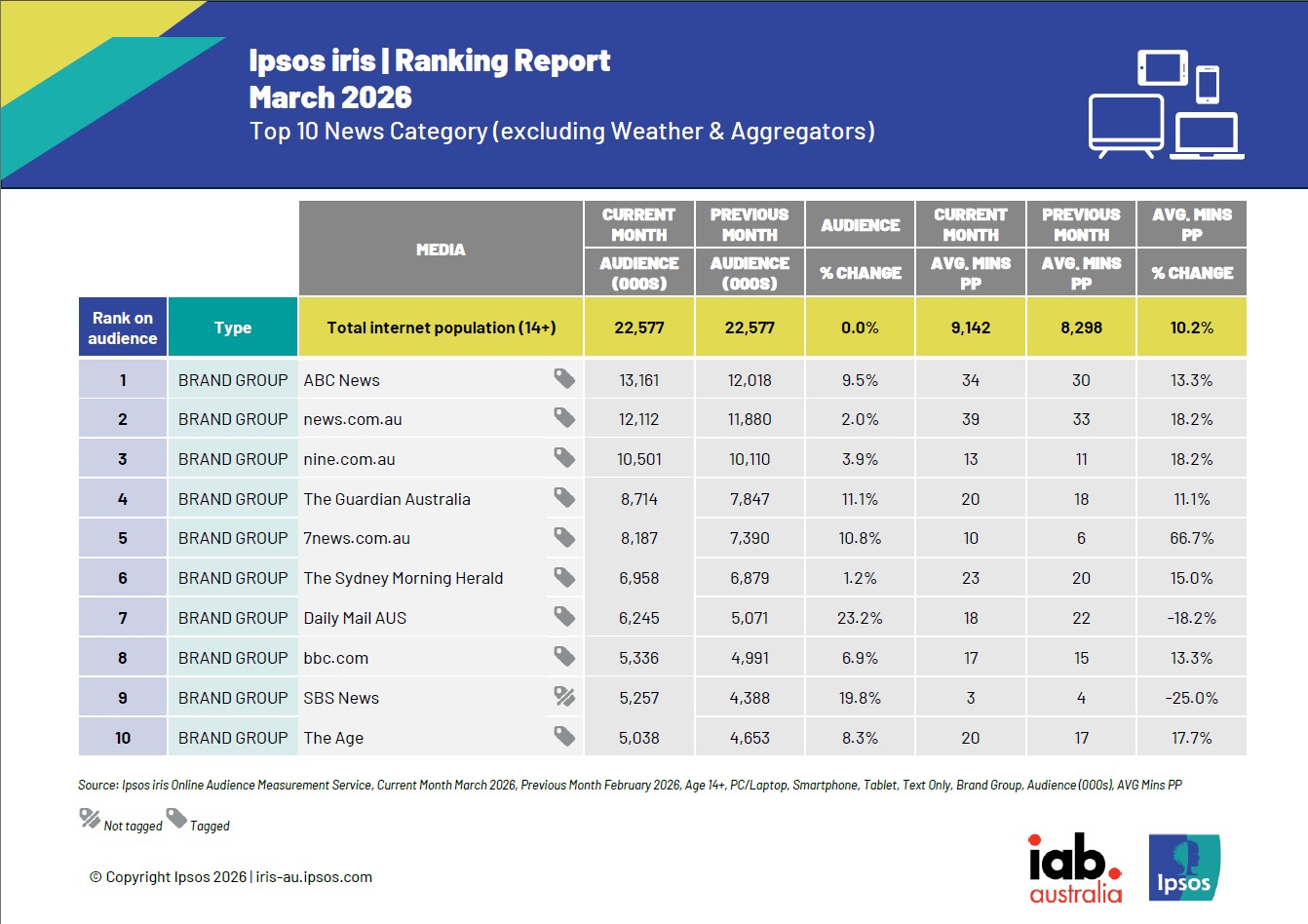
The chart below shows the News brands’ ranking during March 2026 by online audience size.
Career category dominates in March
The career category dominated year-on-year growth in March, rising by 3.8%. This was followed by homes and property, which was last month’s top category (+ 3.2%), automotive and events and attractions (both + 2.8%) and entertainment (+2.5%).
Ipsos iris, Australia’s digital audience measurement currency endorsed by IAB Australia, showed that a total of 22.57 million Australians aged 14+ used the internet in March, up 2% compared to the same time last year, and spent an average of 4.9 hours daily online, up 1.7% compared to the same time last year.
The most consumed categories in March were social networking (22.49 million), search engines (22.47 million), online media (22.44 million), technology (22.39 million), and entertainment (22.22 million).
Ipsos iris provides accurate data about the 22.57 million Australians aged 14+ who access a wide variety of digital content and services across smartphone, PC/laptop and tablet devices.
Notes for editors:
- Ipsos iris is an independent source of truth for the media industry providing a level playing field for comparison of audience reach and characteristics and supporting the $18.4 billion Australian online advertising market (Source; IAB Australia Internet Advertising Revenue Report prepared by PWC CY25)
- Ipsos iris provides accuracy in solving cross-device deduplication, the biggest challenge in measuring online audiences, using a single-source multi-device panel measuring activity on 8,000 smartphone, PC, laptop and tablet devices
- Ipsos iris provides accurate data about the number of people who visit the content of digital publishers and platforms, along with the frequency of visits and time spent by tracking digital audience behaviour across desktop/laptop, smartphone, and tablets. It uses a hybrid methodology that combines metered data from a high quality, nationally representative, single-source passive panel with site-centric census measurement via media owner tagging.
- In February 2024, the CTV audience currency integration from a data partnership with OzTAM launched, providing total unduplicated digital audience currency data for BVOD across CTV, smartphones, tablets, and computers.
- In August 2024, enriched YouTube audience reach and watch time data for Connected TV across mobile, desktop and tablets was integrated into Ipsos iris, in collaboration with Google and IAB Australia.
- Ipsos iris is fully privacy compliant and cross-media ready and will continue to evolve with a roadmap of enhancements over 2024 and beyond. It will also be adaptable to changing requirements as the industry develops in future years.
- The launch of Ipsos iris with monthly data from January 2023 was the culmination of extensive work by the IAB and its Measurement Council that commenced in early 2021 with a strategic review of industry requirements. Ipsos was awarded the IAB’s endorsement, having best met the standards on criteria across all areas of product along with criteria for operations and a future roadmap.
- Further information can be found at: https://iris-au.ipsos.com/